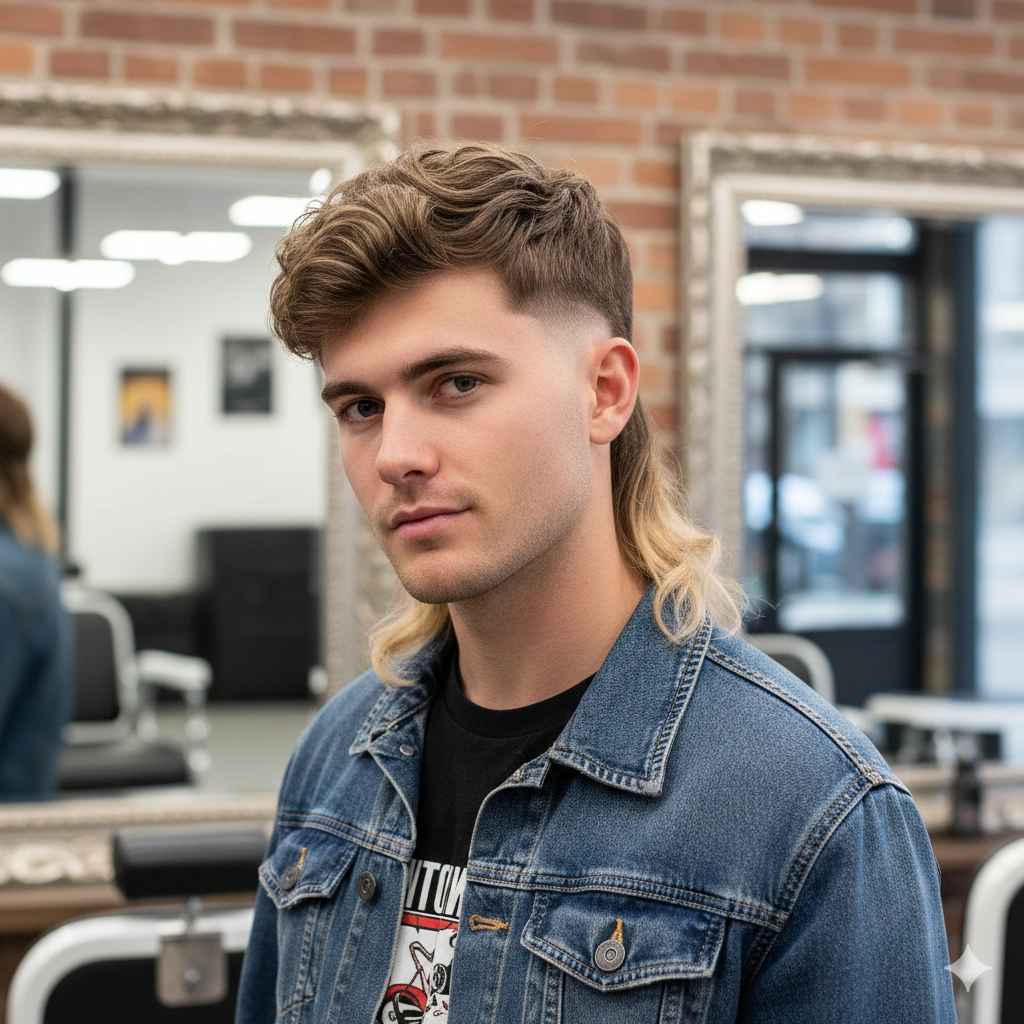
If you’re still thinking of the mullet as a punchline, you’ve already missed the memo in 2025, the modern mullet fade is the most requested style in US barbershops, and it’s not slowing down.

The mullet’s journey is one of fashion’s greatest redemption arcs. Born in the 1960s and exploding in the ’80s across rock stages, hockey rinks, and football fields, it defined an era. By the ’90s it was a joke. But cultural cycles are relentless, and what went out came crashing back only this time, precision barbering techniques transformed it into something completely different.
The modern mullet fade replaces the blunt, ungraduated sides of the original with crisp high fades, skin tapers, and burst fades borrowed from contemporary barbershop culture. The silhouette is the same. The execution is entirely new. Where the ’80s version was accidental cool, the 2025 version is deliberate, architectural, and confident.
In the US, this cut has become a symbol of individuality. Athletes, musicians, skaters, and creatives in every major city are wearing it as a statement: that you’re secure enough to stand out, bold enough to own your identity, and sharp enough to do it with precision. Search data shows consistent year over year growth in mullet related queries, and barbers report it as one of their top requests among clients aged 18–35. This is not a flash trend it’s a movement.
Below is everything you need: the right fade for your face shape, 15 variations to choose from, a word for word barber script, and a daily styling routine that takes under five minutes. Let’s get into it.
Not All Mullets Are Equal: Choosing the Right Fade for Your Face Shape

The single most overlooked variable in choosing a mullet fade is face shape and getting it wrong is the difference between looking intentional and looking accidental. Here’s the analytical breakdown no competitor is giving you:
| Face Shape | Best Fade | Why It Works |
|---|---|---|
| Oval | High Fade / Drop Fade | Balanced proportions handle bold height contrast. A high fade highlights strong cheekbones and amplifies the mullet’s dramatic length difference. |
| Round | High Skin Fade | Tight skin sides create height at the crown, lengthening the face visually. Avoid low fades they widen an already full jaw. |
| Square | Low Taper / Mid Fade | Keeps weight on the sides to soften sharp angles. A skin fade on a square face can look harsh; the mid fade strikes the right balance. |
| Heart | Burst Fade / Low Taper | The burst fade’s arc adds visual weight near the jaw, balancing a wide forehead and drawing the eye downward naturally. |
| Oblong | Mid Fade + Textured Top | Avoid extra height. A mid fade with a textured, side swept top adds width rather than length, balancing a narrow, elongated face. |
Beyond face shape, consider hair texture. Thick hair holds fade lines crisply; finer hair may need a skin fade to maximize contrast. Always mention cowlicks to your barber they affect nape fall and how long your fade stays sharp between cuts.
15 Trending Modern Mullet Fade Variations for 2025
Whether you’re booking your first mullet or switching up your current look, here are the definitive styles dominating right now each with the specs you need before sitting down.
Burst Fade Mullet
A semicircular fade arcs dramatically around the ear, making the length drop look architectural and intentional. It’s the loudest, most street ready version of the modern mullet fade.
Best For: Straight to wavy, medium thick | Maintenance: High
Curly Taper Mullet
Natural curl patterns stay loose and voluminous on top while a clean taper closes the sides. It celebrates texture instead of fighting it barbershop precision meets bohemian freedom.
Best For: Naturally curly / coily | Maintenance: Medium
Wolf Cut Hybrid
Longer curtain bangs, soft layers, and a shaggy back merge the shag and the mullet into one plausibly deniable masterpiece. It reads artsy before it reads mullet.
Best For: Wavy or fine to medium | Maintenance: Medium
Skin Fade Mullet
Sides taken completely to skin with a razor sharp line separating them from the longer back. Maximum contrast, zero subtlety the cut that makes the whole room recalibrate.
Best For: Straight / slightly wavy, thick | Maintenance: High
Low Taper Mullet
A gradual reduction just above the ears keeps some weight on the sides while the back does all the talking. The mullet you can wear Monday through Sunday without a second glance.
Best For: Fine to Medium Hair Easy to Maintain

Textured Crop Mullet
Choppy, point cut top meets a defined fade and a deliberate short tail. French crop energy with mullet attitude photographs like a fashion editorial, styles in two minutes.
Best For: Straight / slightly wavy, fine | Maintenance: Low
Disconnected Mullet
The top section is intentionally unblended from the faded sides a sharp floating effect that signals you’re not following the trend, you’re running ahead of it.
Best For: Thick, straight | Maintenance: High
Afrollet (Afro Mullet)
Full, tall coils at the crown, clean faded sides, and a natural flowing back. A flat out celebration of volume, identity, and what natural texture looks like at its most powerful.
Best For: Type 3C–4C coily / kinky | Maintenance: Medium
Bleached Tip Mullet
Classic fade structure with sun kissed or dip dyed ends on the back section. Surf culture meets downtown art gallery the color carries the personality so the cut stays versatile.
Best For: Any healthy hair | Maintenance: High
Undercut Mullet
Hard shaved sides hidden beneath a longer top that’s combed back or left loose, revealing the undercut like a hidden detail. Classic from the front, unmistakable from the side.
Best For: Thick, straight or wavy | Maintenance: Medium
Edgar Bang Mullet
A blunt horizontal fringe (Edgar style) with faded sides and a mullet back. Hard angles and zero apologies bridges Latino barbershop culture with mainstream street style.
Best For: Thick, straight, strong hairline | Maintenance: Medium
Shaggy Mullet
Long, layered, and intentionally undone soft fade, wispy back, zero over styling. It looks like you just got off stage at a 1975 festival, and that’s exactly the point.
Best For: Wavy / fine; great for growers | Maintenance: Low
High Top Mullet
A structured flat top or angular high top transitions into a fade with a classic mullet drop. Retro architecture thrown into 2025 structured, bold, completely its own thing.
Best For: Thick, straight to coily | Maintenance: High
Hard Part Fade Mullet
A razor shaved line creates a crisp geometric divide in the fade. The contrast between the geometric part and the flowing back is where 2025 barbershop craft lives.
Best For: Straight to wavy, medium–thick | Maintenance: Medium
Tinted / Color Rinse Mullet
Any fade mullet silhouette but the color does the heavy lifting. Subtle rinse, vivid statement shade, or lived in balayage. Proof that hair is a creative medium, not just maintenance.
Best For: All types; healthy, moisturized | Maintenance: High
How to Talk to Your Barber: The No Regret Script

Most chair disappointments aren’t about the barber’s skill they’re communication failures. Walking in and saying “I want a mullet” in 2025 can still trigger an autopilot ’80s cut. Here’s how to take control of that conversation from the first sentence.
Know Your Numbers
Clipper guards are measured in eighths of an inch. A #1 is 1/8″ (very short), #2 is 1/4″, #3 is 3/8″. For most modern mullet fades, you’re looking at a skin fade (0–0.5) on the lower sides, blending up to a #2 or #3 at the temples. The word “blend” signals smooth transitions use it.
Decide Your Nape Length First
The nape is where the mullet lives. Before your appointment, know whether you want it long and flowing (2–4 inches past the collar), medium (landing at the collar), or a subtle business mullet tail (half an inch below). Come in with this number your barber will respect the precision.
Ask for These Techniques by Name
Point cutting (scissors angled into the ends to remove bulk while keeping movement) is what separates a natural, textured top from a blunt helmet. For softer back sections, ask about slide cutting or razor work on the ends. Naming these techniques signals you’re informed and earns you a barber’s full creative investment.
QUICK WIN: Screenshot a 2024–2025 reference photo before your appointment. Show it to your barber before they touch your hair. This single step eliminates 90% of communication errors.
The Exact Script Read This Out Loud
“I’d like a modern mullet fade not an ’80s style mullet. On the sides: a [high/mid] fade going to the skin, blending up to a #2 or #3 at the temples. Keep the top textured with some point cutting. In the back, I want the length to [fall to my collar / sit 2 inches below the nape]. Clean up the nape with a slight curve. I have a reference photo does this work with my hair type?”
Killing the ‘Trashy Mullet’ Fear for Good
The entire difference between a modern mullet fade and its dated predecessor is in the name: the fade. An ’80s mullet has zero graduation just a hard line where cut meets long. The modern version is defined by its gradient: skin tight sides that flow into the top through technical precision. Use the word “fade,” specify “skin tight sides,” and bring a 2025 reference photo. That combination is bulletproof.
Managing the Awkward Phase & Your Daily Styling Routine
Here’s the honest truth every mullet guide skips: the awkward growth phase is real. Unless you’re starting from medium length hair, you’re looking at 6–10 weeks before the cut fully clicks. These three tips will get you through it with your confidence intact.
3 Tips for Surviving the Growth Phase
- Book fade touch ups every 3–4 weeks. Side fades grow out faster than you think. Keeping them tight makes the overall silhouette read intentional even while the back is still growing. A 15 minute touch up appointment is all it takes.
- Define the back with a styling product. During the collar length limbo, a small amount of lightweight gel or curl cream separates the ends and makes the length look deliberate, not forgotten.
- Trust the reference photo. Save your target style and look at it during the frustrating weeks. Growth phase discouragement is the #1 reason people abandon the mullet before it’s fully formed. Your barber can also “shape without removing length” to keep things tidy as it grows.
The 5 Minute Morning Styling Routine

Minute 1 Towel Dry & Rough Shape: Pat hair to 70% dry. Use fingers to push the crown slightly forward and shake the back loose.
Minutes 2–3 Sea Salt Spray: Mist a texturizing sea salt spray through the damp top and back. Scrunch the back upward with your palm to encourage movement. This adds grip for the next product and creates the lived in texture the modern mullet fade is known for.
Minutes 4–5 Matte Clay: Warm a pea sized amount between your palms and work through the top using a raking motion. Use a touch on the ends of the back to separate and define. Avoid glossy products matte finishes keep the look natural and current, not greasy. Style the crown slightly away from your face for height and freshness.
Pro tip: On day 2, skip the sea salt spray and go straight to a light dry texture spray or a small amount of clay. The mullet actually looks better with a little extra texture between washes so skipping the shampoo is a stylistic choice, not laziness.
The modern mullet fade rewards the bold. Own the growth phase, trust the fade, and maintain the sides and you’ll have a cut that turns heads for all the right reasons.
Leave a Reply